Unraveling the biological roots of sexual orientation
Explore the scientific evidence that shapes our understanding of sexual orientation. This page delves into the prenatal factors influencing homosexuality, offering insights into a complex and fascinating area of research.
Key ideas

Beyond social influences
Sexual orientation is not merely a product of early social interactions. Research highlights a compelling body of evidence indicating that prenatal factors, including hormones, genes, and immune reactions, play a crucial role in its development. This understanding shifts the focus from learned behavior to innate biological predispositions, offering a more complete picture of human diversity.
Biological insights
Among the most significant findings, it was observed that girls exposed to excess androgens prenatally show an increased incidence of homosexuality. Furthermore, studies on twins reveal that monozygotic (identical) twins share their sexual orientation more frequently than dizygotic (fraternal) twins, pointing to a genetic component. Another notable pattern is the marked increase in the incidence of male homosexuality for each older brother born to the same mother, suggesting a maternal immune response.


My history
Via my research on the endocrine bases of sexual differentiation, I became aware of all this research concerning the potential prenatal mechanisms that influence sexual orientation. I decided in 2010 to gather this information in a book for the general public. I translated this book in English in 2012 (see below).
Context
In France and in latin countries in general, there is a widespread resistence to the idea that any aspect of human behavior could be controlled by biological mechanisms and in particular by genetic influences. Correlatively, it is broadly assumed that homosexuality, and thus more broadly sexual orientation, is determined either by early relationships with the parents (the Freudian Oedipus complex that would not be properly resolved) or more generally by social interactions that would condition the gender and sexual orientation of an individual (gender theory).
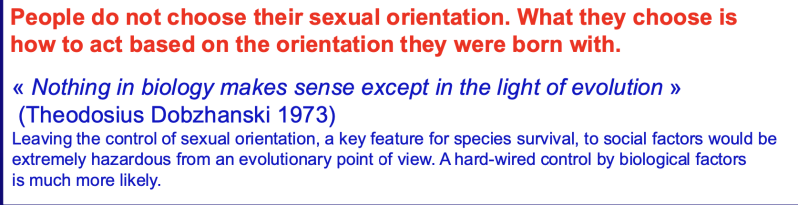
More than 50 years of work on the biological mechanisms of sexual differentiation and the contact with many scientists working in this field mainly in the United States convinced me that sexual orientation is largely one aspect of sexual differentiation controlled by the early action of gonadal hormones (testosterone and estradiol) or more directly by genetic influences. This is clearly demonstrated in animal models and correlative evidence strongly suggests that mechanisms identified in rodents and other mammals are active in humans. As a biologist, I also have a very hard time understanding how evolution could have left the control of sexual orientation to mechanisms as highly variable as the interactions with parents and peers when this feature has such a crucial role in reproductive success and this transmission of genes to the next generation. Control of this feature must be « hard-wired »!
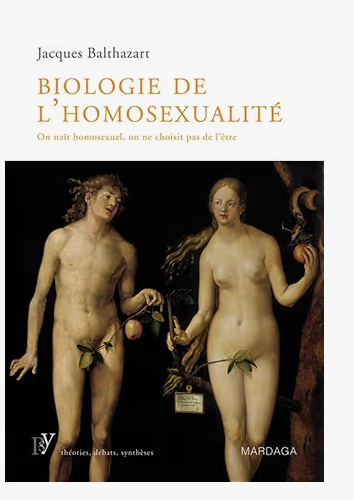
In 2006, Stephane Clerget, a psychiatrist based in Paris (FR) published a book claiming to present a synthesis between biological and psycho-analytical (Freudian) explanations of homosexuality (« Comment devient-on homosexuel, 2006, J.C. Lattes, Paris). Upon reading, it became clear however that this book was refuting all biological interpretations and was in fact an apology of psycho-analytical explanations. I then felt compelled to write a rebuttal to this book and this was published in 2010 under the title: « Biologie de l’homosexualité: on nait, on ne devient pas homosexuel » (Mardaga, Wavre BE 2010).
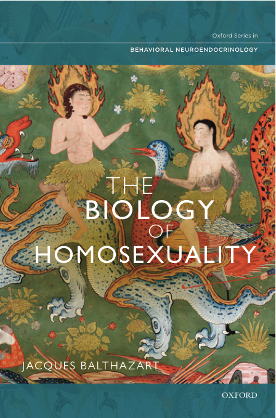
The book raised a lot of interest and discussion in the French media (written press, radio and TV). An english edition was latter published by Oxford University Press (2012, NY USA: "The biology of Homosexuality"). These pages summarize the currently available scientific data that suggest, if they do not prove, the existence of biological mechanisms determining or at least strongly influencing sexual orientation and point to links in the media where my books, conferences and interviews on this topic are presented.
Scientific argument
Many people believe that sexual orientation (homosexuality vs. heterosexuality) is determined by education and social constraints. There are, however, a large number of studies indicating that prenatal factors have an important influence on this critical feature of human sexuality. Sexual orientation is a sexually differentiated trait (over 90% of men are attracted to women and vice versa). In animals and men, many sexually differentiated characteristics are organized during early life by sex steroids, and one can wonder whether the same mechanism also affects human sexual orientation. Two types of evidence support this notion.
It has been shown in several animal species that experimental manipulations of the hormonal environment during the prenatal or early postnatal life can reverse sexual partner preferences so that a male will now try to mate with another male and a female with another female. Sexual orientation is thus determined in animals by the perinatal endocrine environment.
This type of experimental manipulation is impossible in humans for obvious ethical reasons but two types of correlative evidence indicate that the mechanisms identified in animals are still functional in humans.
On the one hand, multiple sexually differentiated behavioral, physiological, or even morphological traits are significantly different in homosexual and heterosexual populations. Because some of these traits are known to be organized by prenatal steroids, including testosterone, these differences suggest that homosexual subjects were, on average, exposed to atypical endocrine conditions during development.
On the other hand, clinical conditions associated with significant endocrine changes during embryonic life result in an increased incidence of homosexuality. It seems therefore that the prenatal endocrine environment has a significant influence on human sexual orientation but a large fraction of the variance in this behavioral characteristic remains unexplained to date.
Genetic differences affecting behavior either in a direct manner or by changing embryonic hormone secretion or action are also clearly involved. How these biological prenatal factors interact with postnatal social factors to determine life-long sexual orientation remains to be determined but current evidence clearly points to a very significant role of hormonal and genetic factors in the control of human sexual orientation.
Consequences
Variations in sexual orientation have largely a biological prenatal origin
...and are thus impossible to change in adulthood
...parents and educators are not responsible.
Conclusions
References
These data have been summarized on the Reflexions web site of the University of Liège at the URL:
http://www.reflexions.uliege.be/cms/c_415441/en/sexual-orientation-in-all-its-aspects
The scientific evidence supporting the notion that homosexuality is largely if not completely determined by prenatal or perinatal factors has also been summarized in print in the following papers:
Balthazart, J. & Roselli, C.E. (2022). Hormonal, genetic, immunological: An array of mechanismsbut how do theyinteract, if at all? Archives of sexual behavior, doi.org/10.1007/s10508-022-02469-3.
Balthazart, J. (2020). Sexual partner preference in animals and humans. Neuroscience and Biobehavioral Reviews 115: 34-47.
Conferences
Following the publication of my book in French (2010) and then in English (2012), I have been invited to present many conferences on the book content for the general public A few of them were videotaped and can be found on the web or on my channel Youtube page located at:
https://www.youtube.com/channel/UCdLqErkv6Lye0Z0B36USrUQ
Most of these conferences are in French but one short presentation (30 min) made at the conference of sex differences in Erice, Sicily (May 2019) is now available
https://www.youtube.com/watch?v=H1PWunxQELc
Another longer presentation (60 min) of these data made in December 2023 at the Biotechnology School of Strasbourg for the "New generation of Biotechnologists" is also available on youtube at the URL:
https://www.youtube.com/watch?v=fCR2J6-7k5A
Press, Radio and TV appearences
Most of my Radio and TV appearences are unfortunately in French; see French part of the site for more detail.
Most appearence are published on my youtube channel at:
https://www.youtube.com/@baltha_neurobio
Books published (French, English, others..)
In English
In French

Translations